
TOGETHER | 20.11.2026
Those who walked ahead, and those who follow
Vietnamese Teachers’ Day, 20 November · Teachers from East to West
In the East, a teacher was once addressed as “tiên sinh” in Vietnamese, from the Chinese 先生: literally, “the one born before”. In the West, the word “mentor” comes from a Greek epic nearly three thousand years old. For Vietnamese Teachers’ Day on 20 November, we travelled from East to West, from ancient times to today, and kept meeting the same image: someone who has walked ahead turning back to offer a hand to the one who follows. The first lesson in that image usually begins at home.
A morning of watering
Six in the morning, the sky just turning light. A grandfather carries a watering can out to the porch, his grandchild trailing behind. He does not explain much. He waters slowly, just enough to soak the roots, then sits down on the step. The child asks when the tree will bear fruit. He only smiles: “Not for a long while yet. We’ll water it again tomorrow.”
Most of us have had a morning like that, with a grandparent, a parent, or some other older person in our lives. The lesson was never really about watering. It was about waiting, about doing the same small thing every day, and about trusting that what we tend today will grow on a day we have not yet seen.
Where 20 November began
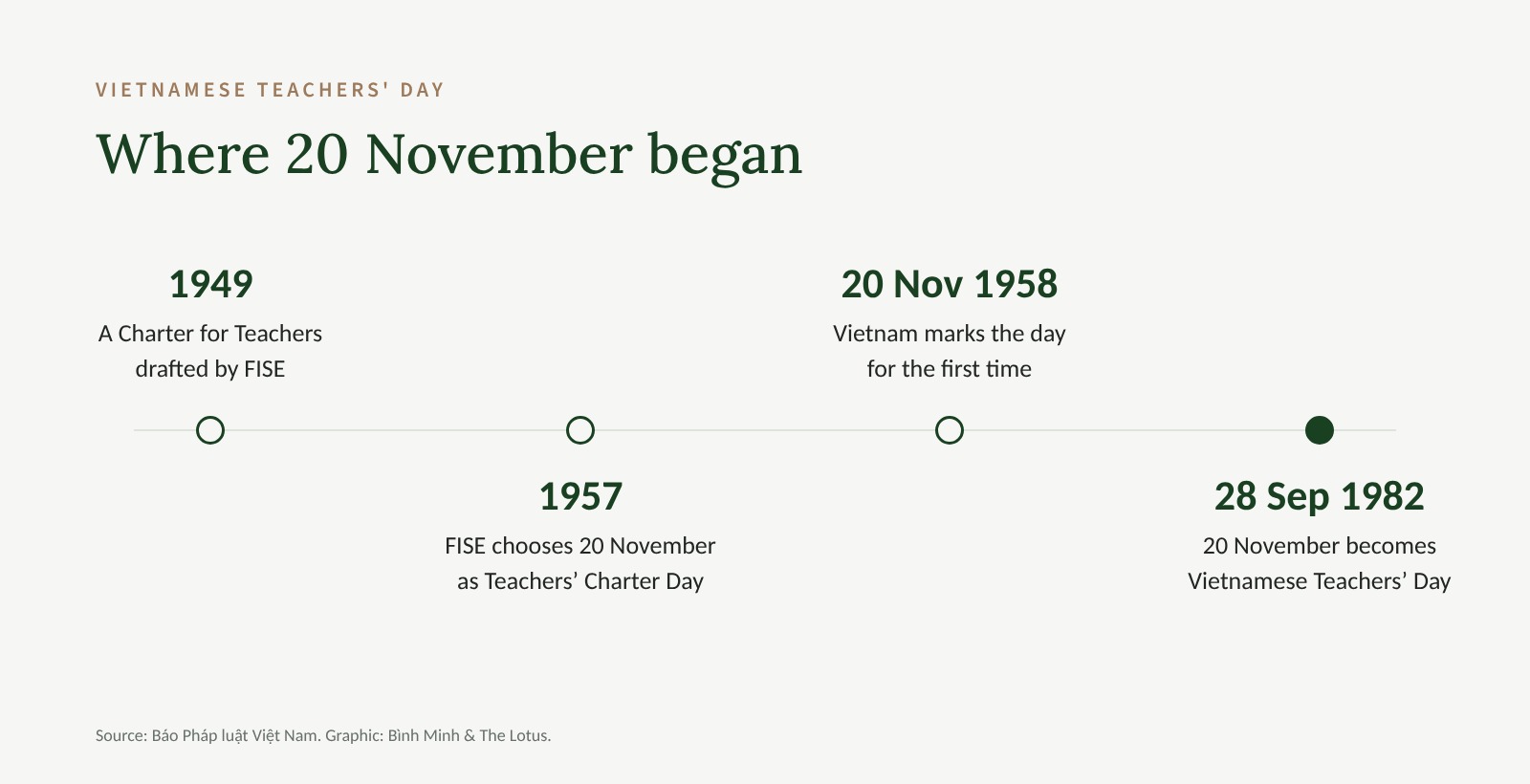
Vietnamese Teachers’ Day traces back to the Charter for Teachers drafted in 1949 by FISE, the World Federation of Teachers’ Unions. In 1957, FISE chose 20 November as International Teachers’ Charter Day. Vietnam first marked the day on 20 November 1958. On 28 September 1982, the Council of Ministers issued Decision 167-HĐBT, making 20 November Vietnamese Teachers’ Day every year (Source: Báo Pháp luật Việt Nam, in Vietnamese).
The day itself is less than seventy years old. Gratitude to teachers is far older, and it is not Vietnam’s alone.
The East: the one born before
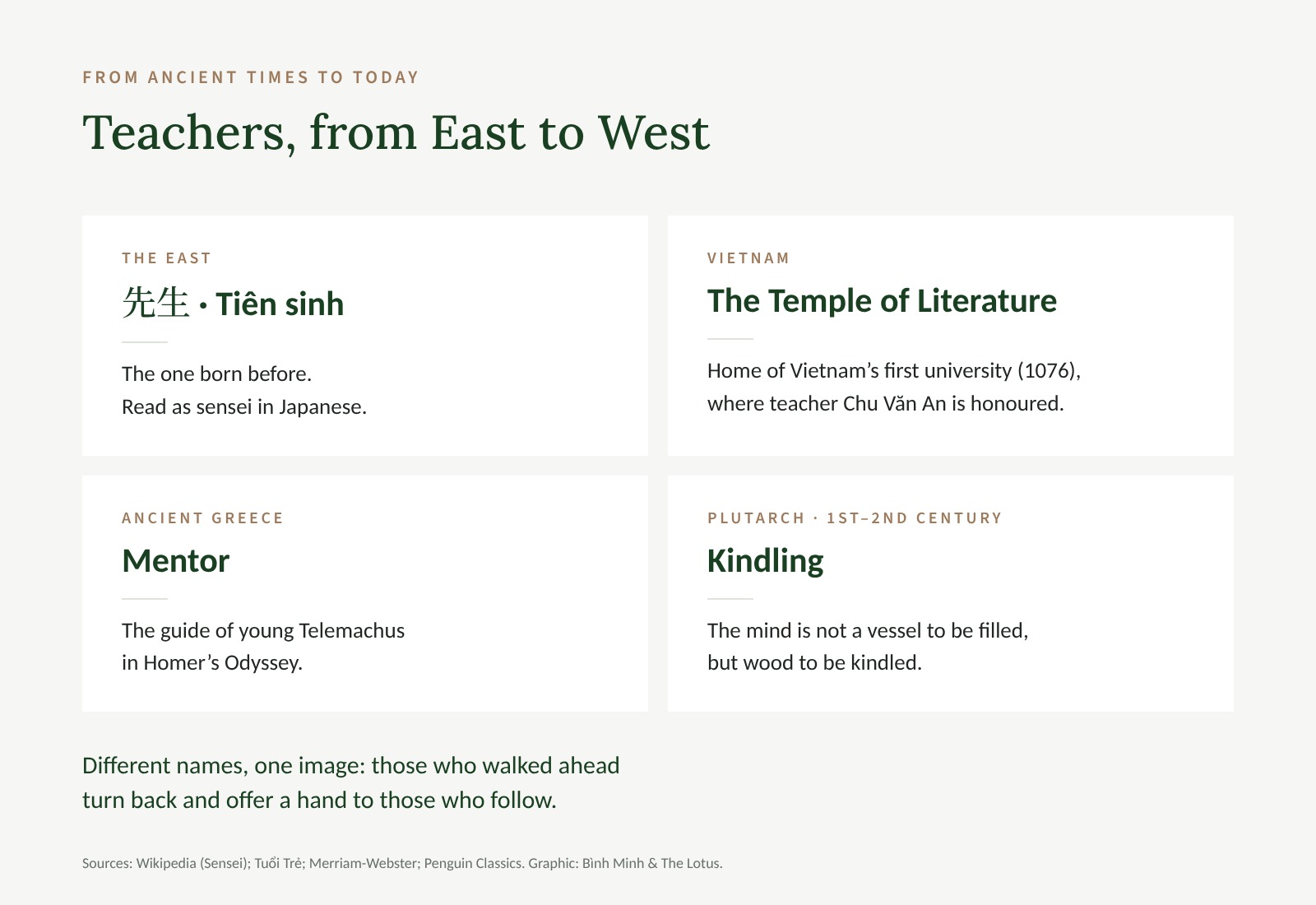
The Chinese characters 先生, read “tiên sinh” in Sino-Vietnamese, literally mean “born before”. In Japanese, the same characters are read “sensei”, still the everyday word for a teacher (Source: Wikipedia, Sensei). There is something lovely in that: a teacher is someone who has gone a little further down the road, then turned back to show us the way.
Confucius reminded his students that the one who walks ahead need not be older: “When three people walk together, one of them is sure to be my teacher. I choose what is good in them and follow it; what is not good, I correct in myself.” (Original: 三人行,必有我師焉。擇其善者而從之,其不善者而改之。Analects, chapter Shu Er. Source: Hong Kong Education Bureau, in Chinese.)
The Guanzi, a text traditionally attributed to Guan Zhong of the Spring and Autumn period, compares teaching people to planting: “Plant once and harvest once: that is grain. Plant once and harvest tenfold: that is a tree. Plant once and harvest a hundredfold: that is a person.” (Original: 一樹一穫者,穀也;一樹十穫者,木也;一樹百穫者,人也。Source: Hong Kong Education Bureau, in Chinese.) That hundredfold harvest does not return to the one who planted. A person raised with care carries it onward, to their children, partners, students, friends and colleagues. It spreads to those who come after.
Vietnam: a teacher honoured at the first university
In 1070, under Emperor Lý Thánh Tông, the Temple of Literature (Văn Miếu) was built in the capital Thăng Long, today’s Hanoi. In 1076, the Imperial Academy (Quốc Tử Giám) was founded beside it. It is regarded as Vietnam’s first university, and it taught students until 1802. Among those honoured here is the teacher Chu Văn An, who served at the Imperial Academy under the Trần dynasty and is remembered as a teacher of talent and virtue, with many accomplished students (Source: Tuổi Trẻ, 21 July 2009, in Vietnamese).
A teacher honoured at the highest seat of learning in the land: this was how Vietnamese people of old gave teachers the place of greatest respect.
The West: the guide
In Homer’s Odyssey, while Odysseus is away for nearly twenty years, his son Telemachus grows up under the guidance of Mentor, a trusted old friend. The goddess Athena later takes Mentor’s form to travel with Telemachus. In 1699, the French writer Fénelon brought the character into The Adventures of Telemachus, and from there “mentor” became an ordinary word for a trusted guide (Source: Merriam-Webster).
Nearly two thousand years ago, Plutarch, a Greek writer of the Roman era, wrote in his essay On Listening that the mind is not a vessel that needs filling, but wood that needs kindling (Source: Quote Investigator, citing Robin Waterfield’s translation, Penguin Classics, 1992). Seen this way, a teacher lights a fire rather than fills a jar.
Every culture has its own word: the one born before, the guide, the one who lights the fire. All of them point to the same image. Someone who walked ahead turns back and offers a hand to the one who follows.
Our first teachers never stood at a lectern
Long before we could read, we learned a great deal at home: to invite our elders to eat first, to set aside a portion for whoever comes home late, to say sorry after breaking a bowl. No one wrote a lesson plan for any of this. We learned by watching the adults around us live, day after day.
The science of child development makes the same point in its own way. Harvard University’s Center on the Developing Child calls the back-and-forth exchanges between a young child and a caring adult “serve and return”, and explains that these exchanges help shape the architecture of a child’s developing brain (Source: Harvard Center on the Developing Child). That adult might be a parent, a grandparent, an aunt or an older sibling: anyone who stays beside a child long enough to answer.
Vietnamese grandparents put it more simply: “Uốn cây từ thuở còn non, dạy con từ thuở con còn bi bô.” Shape a tree while it is young; teach a child while they are still babbling.
When the student teaches the teacher
Confucius’s line about three people walking together feels close to many families today. Anyone who has helped a grandparent make a video call to a grandchild far away knows that the teacher is sometimes the child.
A study by Teresa Correa of Diego Portales University, published in the Journal of Communication, surveyed 242 parent–child pairs and interviewed 14 of them in depth. It found that around 30 to 40% of parents had been taught by their children to use computers and the Internet, and that many parents did not realise they were learning from their children (Sources: ScienceDaily, 24 January 2014; Journal of Communication, DOI 10.1111/jcom.12067).
The study measured learning about technology, not every kind of learning. But it points to something familiar in many homes. Adults teach children manners, patience, and how to see a task through. Children teach adults new things, and remind them to stay curious. Teacher and student take turns, under one roof.
Sống có trước có sau: keeping faith with those before us
Vietnamese has many sayings about gratitude to those who teach us. “Không thầy đố mày làm nên”: without a teacher, you will hardly get far. “Ăn quả nhớ kẻ trồng cây”: when you eat the fruit, remember who planted the tree. “Uống nước nhớ nguồn”: when you drink the water, remember its source. Or, more simply: sống có trước có sau, literally “to live with a before and an after”.
The word tiên sinh reminds us that someone was born before us. Có trước có sau reminds those who come after not to forget it. It means remembering who taught us, even when we have travelled far. It means keeping faith with those who walked ahead, not through grand promises, but by living up to what they taught us. And it means passing on to the generations after us even more than we ourselves received.
Four small things for Teachers’ Day
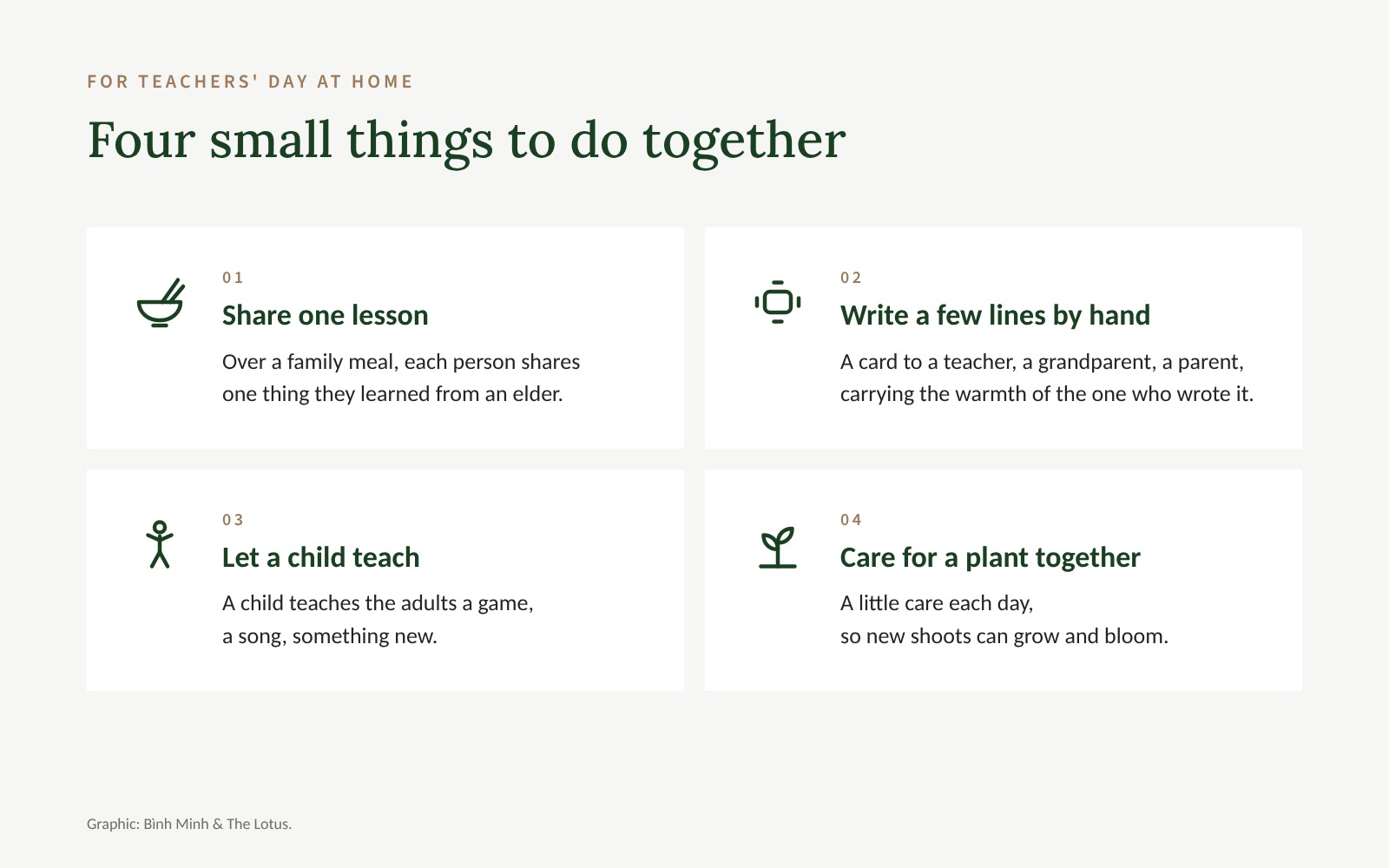
We do not always need an expensive gift to say thank you. Here are a few small things a whole family can do together:
Share one lesson. Over a family meal, each person shares one thing they learned from an older person in their life, and how that person taught it.
Write a few lines by hand. A card to a teacher, a grandparent, a parent. Handwriting carries something of the person who wrote it, so the one who receives it often wants to keep it in their own way: tucked somewhere close, or remembered and passed on to others, just as it was given to them.
Let a child teach the adults something. A game, a song, a new way to use an app. Let a child be the teacher for an afternoon.
Care for a plant together. A small tree in the garden, or a pot of flowers on the balcony. Each day the child asks whether Grandpa has watered it yet; Grandma picks off the yellowed leaves and faded petals so new shoots can come through, the way kindness spreads a little further. That plant will remind the whole family that some things only grow, stay green and bloom when they are tended regularly, and with sincerity.
What a forest has taught us
At Bình Minh & The Lotus, we are closely tied to a coastal forest in Hồ Tràm, Vietnam. The first thing the forest taught us was patience: some things only grow when they are looked after long enough, and what nature has given needs to be kept for those who come after.
We think raising a person is much the same. The spaces we are preparing are meant for many generations to share: places where each person can rest at their own pace, and then come back together. There, adults will sometimes be the students, and children will sometimes be the teachers.
On Vietnamese Teachers’ Day, Bình Minh & The Lotus wishes every teacher, in the classroom and at home, good health and peace. Every generation walks ahead of the next. Thank you to all who walked ahead of us, and turned back to offer us a hand.
Which of your teachers would you like to thank: at school, at home, or both? Leave us a line.
Note: This article draws on the sources cited after each reference. Research findings are reported within the scope in which they were published. Graphics by Bình Minh & The Lotus.
First published on binhminhlotus.com, 20/11/2026. A Vietnamese version is also available.
